Evidence about prostate health and ejaculation conflicts
Explore the available science covering all the known risk factors for prostate cancer check out Prostate cancer risk factors by Cancer Research UK.
Scientists have actually measured many separate factors and their relationship to prostate cancer: 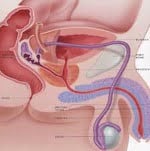 ejaculation, intercourse frequency, marital status, number of sex partners, and cases of sexually transmitted disease. So far, study results conflict with each other on almost every factor, and the medical profession does not consider ejaculation frequency (or infrequency) to be risk factor for prostate cancer.
“On the men’s sites that I frequent, the number one rationalization for masturbation is that it is good for the prostate. All you have to do is tell a guy that jerking off is good for his health and he’s a lifer.”
The popular press has made a lot of noise about isolated aspects of results that make good headlines. The following two studies are the main ones cited as proof that more ejaculation correlates to a decreased chance of prostate cancer.
- G. G. Giles, et al., “Sexual Factors and Prostate Cancer,” BJU International, 92(3), July 2003: 211–216.
- M. D. Leitzmann, “Ejaculation Frequency and Subsequent Risk of Prostate Cancer,” JAMA, 291(13), April 2004: 1578–1586.
First, the decrease risk only applied to ejaculations occurring during the subjects twenties. Second, the data was based on recollections of what occurred decades earlier. Third, the JAMA 2004 study admitted that their conclusion didn’t line up with other studies:
Previous investigations on reported ejaculation frequencies or sexual intercourse and prostate cancer are limited to studies of retrospective design and results are mixed. Nine studies observed a statistically significant1, 23–27 or non significant28–30 positive association; 3 studies27, 31–32 reported no association;7 studies found a statistically significant4–5,10, 33 or non-significant34–36 inverse relationship; and 1 study37 found a U-shaped relationship. Nine4, 24–25,27, 30–32,35–36 of the aforementioned studies found little or no variation in prostate cancer risk according to sexual activity during different ages.
As you can see, studies do not agree on the relationship of ejaculation frequency to the risk of developing prostate cancer. A more recent study found 19% less non-lethal prostate cancer in more frequent ejaculators. (Lethal rates were unaffected.) However, many questions remain unanswered, such as what else the researchers controlled for.
On the other hand, a 2009 study – “Sexual activity and prostate cancer risk in men diagnosed at a younger age” found that masturbation increased prostate cancer risk in the 20’s &30’s, but lowers the risk when the man enters the 50’s. From the study:
Previous results from studies of reported ejaculation frequencies or sexual intercourse and prostate cancer are mixed, and include studies reporting inverse [10], positive [20] or no associations [19].
Whereas frequent overall sexual activity in younger life (20s) increased the disease risk, it appeared to be protective against the disease when older (50s). Alone, frequent masturbation activity was a marker for increased risk in the 20s and 30s but appeared to be associated with a decreased risk in the 50s, while intercourse activity alone was not associated with the disease.
From this 2003 review of the literature “Frequency of Sexual Activity and Prostatic Health: Fact or Fairy Tale?” in Urology.
These cross-sectional data suggest that the frequency of ejaculation has no effect on lower urinary tract symptoms, peak urinary flow rates, or prostate volume; the apparent protective association appears to be an artifact caused by the confounding effects of age.
Then there is this: Prostate cancer mortality among Catholic priests.
Clerics experienced mortality ratios of 15% less for all causes of death and 30% less for cancer mortality, given mortality patterns among New York State white males of comparable ages. Twelve deaths from prostatic cancer were observed while 19.8 were expected.
A review of scientific literature in The Journal of Sexual Medicine – The Relative Health Benefits of Different Sexual Activities (2010) – concluded the following:
A wide range of better psychological and physiological health indices are associated specifically with penile-vaginal intercourse. Other sexual activities have weaker, no, or (in the cases of masturbation and anal intercourse) inverse associations with health indices.
The bottom line is that there is no bottom line, just a whole lot of conflicting data, and a few memes put forth as unassailable truth. To explore the available science check out Prostate cancer risk factors by Cancer Research UK.
What’s important to keep in mind that is the men who recover from porn-induced ED or porn addiction generally only eliminate or reduce ejaculation for about 2-5 months, if that. Yourbrainonporn is not an anti-masturbation website, and does not advocate or support long-term abstinence. The goal of this FAQ, and our articles on masturbation, is to allay fear of a temporary abstinence or reduced ejaculation frequency.
I invite you to examine more research data analyzing the supposed benefits of masturbation and orgasm. It may surprise you that not all orgasms are created equal, and that the touted “benefits of orgasm” are correlated to sexual intercourse – not masturbation.
- Masturbation, Recovery and Sexual Health (Jordan Green, SASH)
- YBOP blog post examining the myths surrounding the benefits of masturbation – Rethinking the Wonders of Adult Masturbation
- From The Archives of Sexual Behavior – Masturbation is Related to Psychopathology and Prostate Dysfunction: Comment on Quinsey (2012)
- From The Journal of Sexual Medicine – The Relative Health Benefits of Different Sexual Activities (2010)
Update: July, 2017 – Also of interest is a recent statement by Richard Wassersug PhD, prostate cancer expert and Faculty of Medicine Professor, Faculty of Medicine at the Department of Urologic Sciences at the University of British Columbia:
“There are no really good objective data that I know of showing a causal link (positive or negative) between ejaculation frequency and prostate cancer risk. Recently we reviewed the data for MtF, who have androgen deprivation and they, of course, have a very low incidence of prostate cancer and presumably depressed frequency of orgasm.”
Two lines of research look promising:
- Viral and bacterial infections appear to be the underlying cause of much prostate cancer. Mounting evidence suggests that prostate cancer is an infectious, sexually transmitted disease caused by a recently identified virus. Also, men with a bacterial infection were also more likely to have advanced prostate cancer, perhaps due to increased inflammation.
- Healthy lifestyle may prove to be the best protection against prostate health. A recent study on prostate health suggests that holistic lifestyle changes can turn off disease-promoting genes, and activate beneficial ones. In the study, the prostate health (of patients with prostate cancer) responded dramatically to stress management techniques (participation in a weekly support group, yoga-based stretching, breathing techniques, meditation, and daily guided imagery), walking thirty minutes per day, and dietary supplements.After three months, researchers repeated a biopsy of normal tissue in the subjects’ prostate. They found that genes associated with cancer, heart disease, and inflammation were down-regulated or “turned off,” while protective, disease-preventing genes were “turned on.” See Dean Ornish, “Changing Your Lifestyle Can Change Your Genes.” Researchers suggest that similar lifestyle changes may benefit all men, as the biopsies were of healthy tissue. Might daily affection someday prove to be one such beneficial lifestyle change?